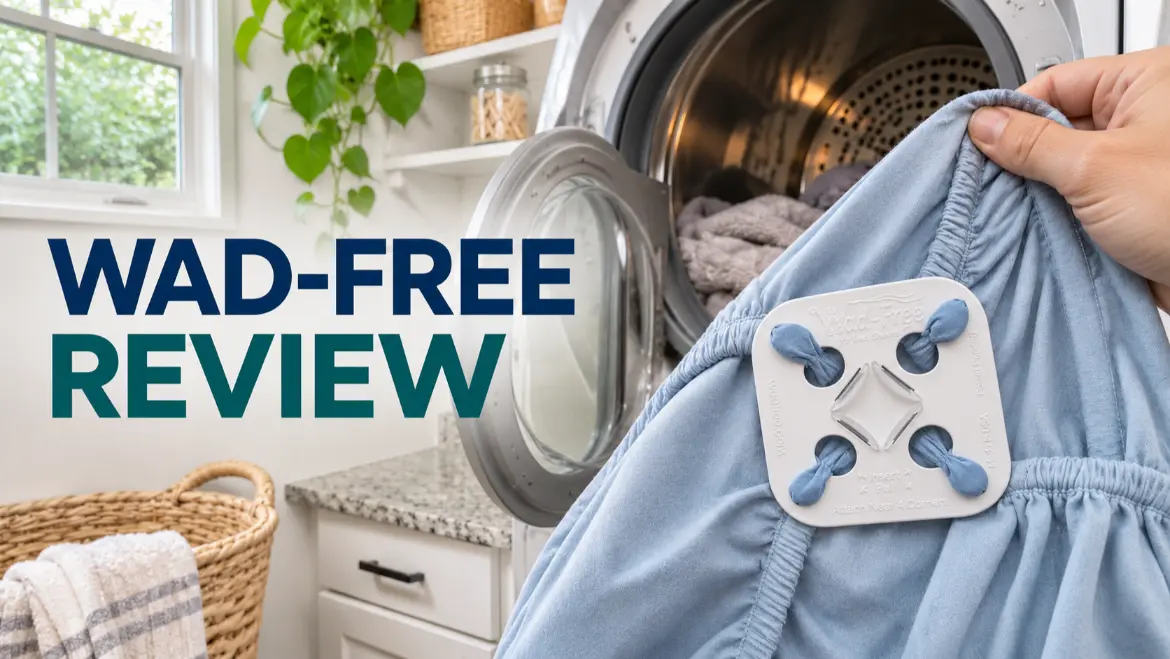
This Wad-Free review examines a deceptively simple laundry tool designed to stop flat and fitted sheets from twisting into tight bundles. The basic idea is sensible: secure a sheet’s four corners to one reusable frame so the fabric cannot swallow towels, pillowcases, or the other sheet during washing and drying. The difficult question is whether that convenience justifies the extra setup and roughly $20 price.
Quick verdict: Wad-Free appears most useful for households that repeatedly find damp laundry trapped inside a fitted sheet or must stop the dryer to separate a tangled bundle. It is less convincing as a universal drying-time shortcut. Independent tests have produced very different results, and correct attachment, sheet size, fabric, load volume, and appliance capacity all influence performance.
The practical conclusion of this Wad-Free review is that anti-tangling performance matters more than a headline drying-time claim.
The strongest reason to consider it is preventing sheet entanglement, not assuming every load will dry dramatically faster. If your sheets rarely wad up, you use rayon-based bedding, or you prefer high-spin and high-heat cycles, this probably is not the right laundry accessory.
This Wad-Free review also explains how to judge the product in your own appliances without mistaking one lucky load for a dependable result.
Table of Contents
Wad-Free Review at a Glance
| Detail | What to know |
|---|---|
| Product | Wad-Free for Bed Sheets |
| Purpose | Helps reduce twisting, tangling, balling and laundry becoming trapped inside sheets |
| Package contents | Two sheet detanglers, enough for one flat sheet and one fitted sheet |
| Current official price | $19.99 when checked November 27, 2026 |
| Where it is used | Washer and dryer, while remaining attached to the sheets |
| Compatible sheet sizes | The manufacturer says it works with flat or fitted sheets of any size when the appliance adequately fits the bedding |
| Important fabric exclusions | Not for silk or rayon-based fabrics, including bamboo, eucalyptus, beechwood, viscose, modal, lyocell and Tencel |
| Recommended settings | Follow the sheet label; gentle or normal washing, cold or warm water, low or medium spin, and low or warm drying are generally recommended |
| Return policy | US orders purchased from the official site may be returned within 30 days of receipt; return shipping is generally the buyer’s responsibility |
| Best for | Households frequently dealing with tangled sheets, trapped pillowcases and damp centers |
| Main drawback | Requires attaching eight sheet corners per bedding set, and a corner can release if it is not secured correctly |
The specifications in this Wad-Free review were checked against the official product, instruction, FAQ and policy pages on November 27, 2026.
Our Wad-Free review is based on the manufacturer’s current instructions and policies plus independently published testing. We have not claimed that StoreZiller personally washed sheets with the device because no original test data was supplied for this article.
What Is Wad-Free and How Does It Work
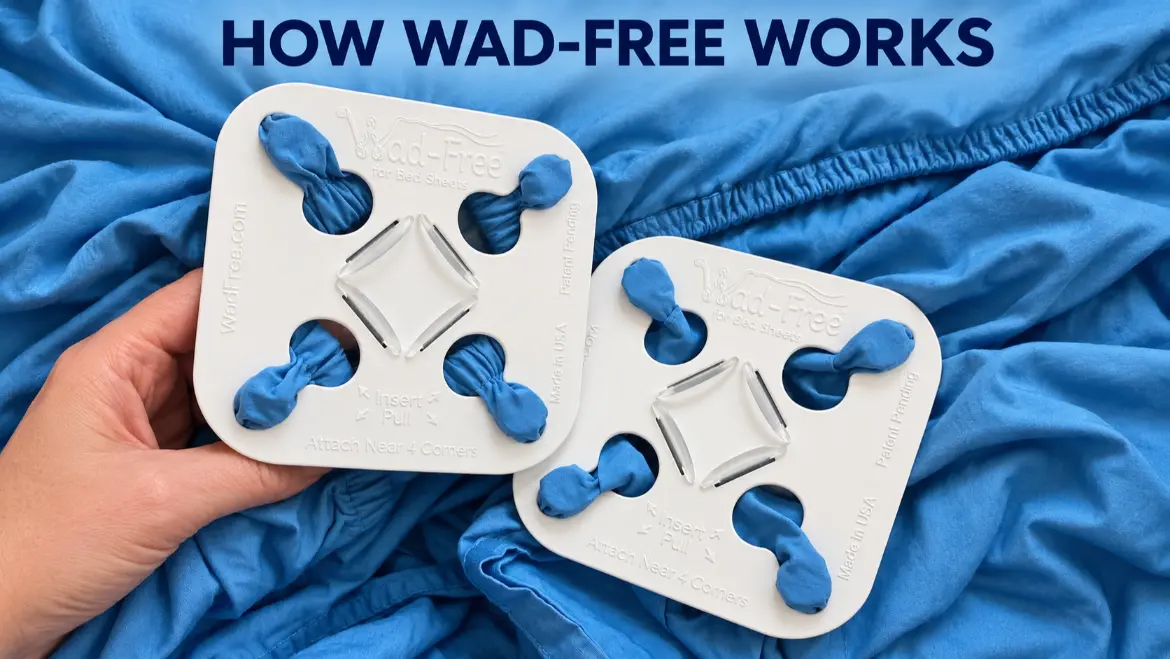
Wad-Free is a reusable, rounded-square plastic frame with four openings and four clear flexible tabs. Each corner of a flat or fitted sheet is secured to one tab. When all four corners are attached, the gathered sheet resembles a small parachute.
For shoppers reading a Wad-Free review for the first time, it helps to understand that the product does not clip four separate accessories to the sheet. One frame organizes all four corners.
The frame limits how freely the sheet corners can wrap around one another. This is intended to reduce sheets balling up, stop smaller items from becoming trapped inside a fitted sheet, and help water and heated air reach more of the fabric.
The package contains two devices because each sheet needs its own Wad-Free. A standard bedding load containing one flat sheet and one fitted sheet therefore uses both pieces. The manufacturer also sells a different version intended for blankets and duvet covers, so shoppers should not assume the bed-sheet version is designed for every bulky laundry item.
The product became widely known after appearing on Shark Tank Season 13 in 2021. Its inventor, Cyndi Bray, presented it as a solution to a familiar laundry problem: sheets forming a dense bundle that remains wet in the center or traps other items.
The Shark Tank story creates interest, but this Wad-Free review bases its verdict on function, limitations and independent observations rather than television exposure.
According to the official Wad-Free product page, the base is made to tolerate the washing and drying process when users follow the sheet-care and product instructions. The official FAQ identifies the base material as polypropylene and the tabs as thermoplastic elastomer. It also states that the product contains no latex, PVC, BPA, or phthalates.
How Does Wad-Free Work?
This Wad-Free review found that the concept depends more on controlling the corners than flattening the entire sheet. A loose sheet can fold, twist, and form a pouch. Once towels or pillowcases enter that pouch, the outside may dry while the contents and inner layers remain damp.
That movement-based explanation is central to the Wad-Free review because the device does not change the washer or dryer itself.
Wad-Free gathers the four corners into fixed positions around a central frame. The sheet can still move and tumble, but it has less freedom to wrap into a long rope or sealed bundle. That may improve separation and airflow, although it does not guarantee a particular drying-time reduction.
The device is not a powered appliance and does not add heat, airflow, or agitation. Its potential benefit comes entirely from changing how the sheet moves inside the drum. Results will therefore depend heavily on the washer, dryer, sheet dimensions, fabric weight, load composition and whether the appliance has enough open drum space.
A balanced Wad-Free review should therefore avoid promising identical performance across compact, standard and large-capacity machines.
If you enjoy practical household upgrades, StoreZiller’s Home and Kitchen guides cover other products intended to simplify routine chores. Wad-Free belongs in that convenience category rather than being treated as an essential appliance component.
How to Use Wad-Free Correctly
The setup is simple after practice, but it is not completely intuitive on the first attempt. The clear round tab should be covered with sheet fabric before being pushed through the frame opening. The sheet itself should not simply be threaded through the hole.
Correct setup deserves extra space in this Wad-Free review because improper attachment is one of the clearest reasons for disappointing results.
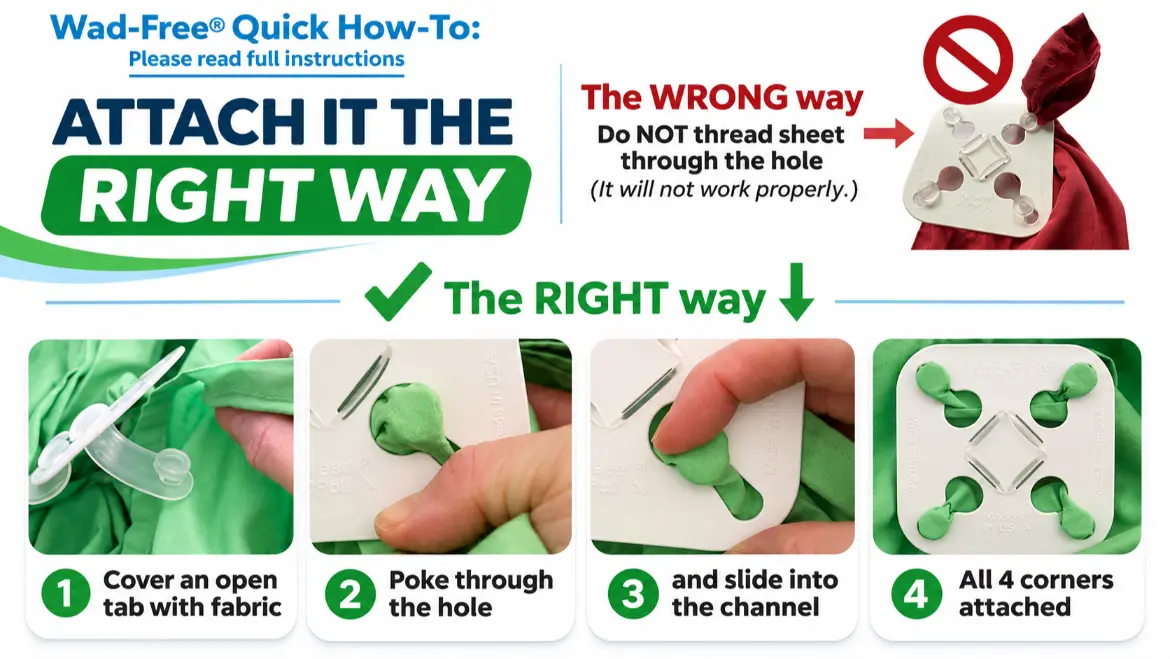
Follow these steps:
- Slide a clear round tab toward the center to release it.
- Cover the open tab completely with fabric near one sheet corner, leaving enough fabric slack.
- Push the fabric-covered tab through the round opening in the frame.
- Slide the covered tab down into the channel.
- Gently tug the sheet to confirm that the corner is secure.
- Repeat for all four corners.
- Attach the second Wad-Free to the second sheet.
- Fluff each attached sheet so it resembles a parachute before loading it separately.
- Leave the devices attached while transferring the sheets from washer to dryer.
- Remove them only after the drying cycle is complete.
The official Wad-Free instructions recommend gentle or delicate washing and warn against high spin speed. Always follow the lower or more cautious limit when the sheet-care label and accessory instructions differ.
Fitted Sheets With Thick Elastic
Thick elastic or deep-pocket construction can make the standard edge position less reliable. The manufacturer suggests an alternate attachment point along the corner-pocket seam, approximately 10 to 24 inches or more from the elastic edge. Users may need to experiment within the official guidance to find a secure double layer of fabric.
This Wad-Free review recommends checking the sewn construction of a fitted sheet before choosing the standard or alternate position.
This detail is easy to miss in a brief Wad-Free review, yet it may explain why one household reports secure performance while another repeatedly finds a released corner.
Does Wad-Free Stop Sheets From Balling Up?
The available evidence suggests that it can reduce tangling when attached correctly, but it is not infallible. Two prominent competitors reached different conclusions.
The central question in this Wad-Free review is not whether the device can help, but how consistently it helps under different laundry conditions.
Rather than hiding that disagreement, this Wad-Free review uses it to identify the conditions most likely to change performance.
Bob Vila’s reviewer reported using the product for more than a year across over 50 sheet sets. She found that sheets did not emerge as a tightly tangled ball once she learned to secure enough fabric under every tab. She also reported that the device remained in good condition after repeated use.
Reviewed tested Wad-Free in a controlled washer-and-dryer lab. That test found less sheet and towel entrapment, but a corner came loose during both test loads. The publication concluded that the overall time savings did not outweigh the setup hassle for its equipment and loads.
| Question | Bob Vila’s experience | Reviewed’s lab test | Practical interpretation |
|---|---|---|---|
| Did it reduce tangling? | Yes, consistently after the learning period | Somewhat, with less trapped laundry | Anti-tangling may be the product’s strongest benefit |
| Did corners remain attached? | Yes when enough fabric was secured | One corner released in both tests | Attachment technique and sheet construction matter |
| Did it reduce drying time? | Reviewer considered the overall benefit worthwhile | One minute on the sheet-only load; four net minutes on the full-load test | Do not assume the maximum marketing claim applies to every load |
| Was setup easy? | Became automatic with practice | Considered frustrating relative to the benefit | Expect a learning curve and extra preparation time |
| Final verdict | Positive | Negative | Your usual laundry problem determines the value |
This conflict is more informative than a single glowing or dismissive verdict. A large sheet in a compact dryer has different movement and airflow from a smaller sheet in a spacious modern drum. Cotton percale also behaves differently from slick, lightweight or heavily elasticized fabric.
That variability is why this Wad-Free review does not convert another publisher’s result into a universal score.
The answer from this Wad-Free review is therefore conditional: it appears capable of limiting sheet wads, but correct setup and suitable load conditions are essential.
Does Wad-Free Reduce Drying Time?
The manufacturer says sheets can dry up to 75 percent faster. The words “up to” describe a best-case ceiling, not the result every household should expect.
Our Wad-Free review treats that number as a manufacturer claim, not a guaranteed or typical outcome.
Reviewed’s independent test found only a one-minute difference in its sheet-only cycle. Its full mixed load finished drying six minutes faster, but the preceding wash took two minutes longer, producing a four-minute overall difference. Those results do not disprove that larger improvements can occur in another dryer, but they show why shoppers should not calculate guaranteed energy savings from the headline claim.
The drying-time section of this Wad-Free review is intentionally cautious because a result measured in one appliance cannot predict every household’s energy savings.
A Wad-Free may create a larger difference when a household’s normal baseline is especially poor. For example, if a king fitted sheet routinely wraps around the flat sheet and must be untangled halfway through the cycle, preventing that bundle could avoid a restart. If the same sheets already tumble freely, the improvement may be negligible.
For this reason, our Wad-Free review treats faster drying as a possible secondary benefit. The primary purchase case is preventing troublesome tangles and trapped laundry.
Queen vs King Sheets What Changes
A credible test should not treat every sheet size as equivalent. King sheets contain more material and occupy more drum volume than comparable queen sheets. They have more opportunity to fold over themselves, and they leave less free space for tumbling in a small dryer.
Adding a queen-versus-king framework makes this Wad-Free review more useful than a test that reports only one unnamed sheet size.
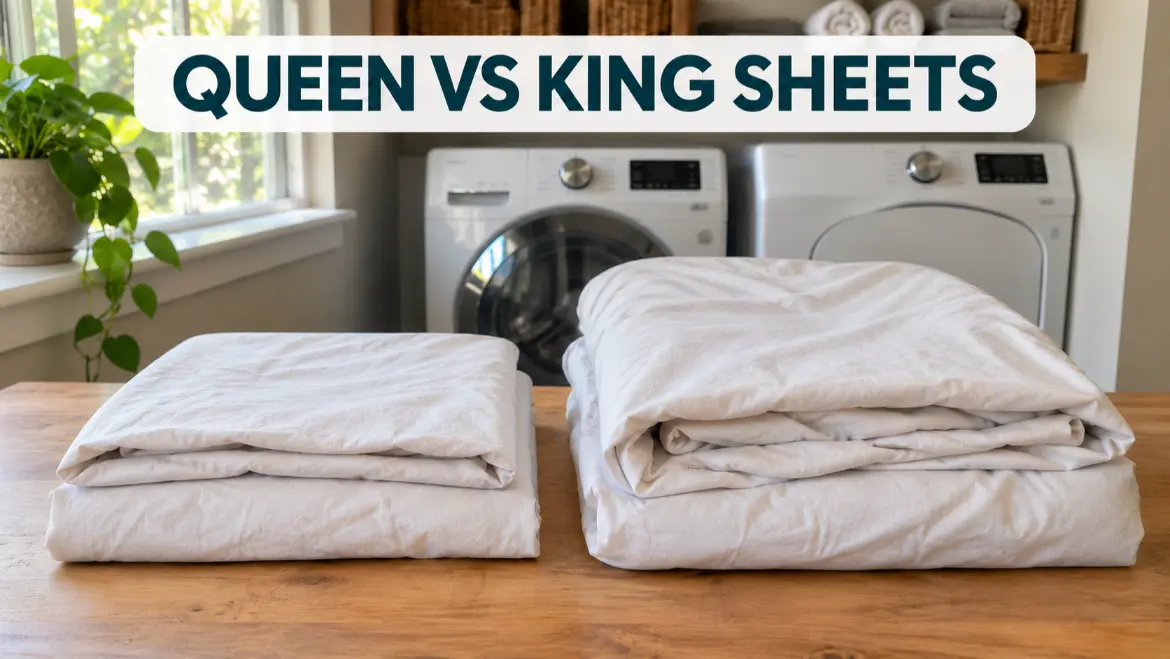
The manufacturer says Wad-Free works with any sheet size provided the appliance amply fits the bedding and is not overloaded. That condition is crucial. The accessory cannot compensate for a drum that is too small to let the bedding move.
A Better Queen-Versus-King Testing Method
StoreZiller did not fabricate results for this Wad-Free review. Instead, here is the controlled protocol that should be used when original testing becomes available:
This preserves the honesty of the Wad-Free review while giving readers a repeatable way to evaluate the accessory.
- Use cotton queen and king fitted-sheet sets with similar weave and fabric weight.
- Record dry weight for each complete set.
- Wash each set alone using the same washer, water temperature, cycle and spin speed.
- Run one control load without Wad-Free and one matched load with it.
- Use the same dryer, heat level, sensor setting and starting drum condition.
- Record total drying time and any manual interruptions.
- Check whether any Wad-Free corner released during washing or drying.
- Inspect the elastic edge and every attachment area for stretching or marks.
- Check the fitted-sheet pocket and folded centers for damp spots.
- Repeat each condition at least three times rather than relying on one cycle.
Use a table like this to record results:
| Test condition | Drying time | Corner released? | Items trapped? | Damp spots and location | Manual untangling needed? |
|---|---|---|---|---|---|
| Queen without Wad-Free | |||||
| Queen with Wad-Free | |||||
| King without Wad-Free | |||||
| King with Wad-Free |
This approach would add more value than repeating a single percentage. It would also show whether Wad-Free helps king sheets more because they begin with a greater tangling problem.
Why Can a Wad-Free Corner Come Loose
A released corner does not necessarily mean the device is broken. Common causes include too little fabric covering the tab, pulling the fabric too tightly, using the wrong attachment area on thick elastic, overloading the appliance or selecting a cycle outside the instructions.
Troubleshooting is part of this Wad-Free review because first-load failure may reflect setup rather than the final potential of the product.
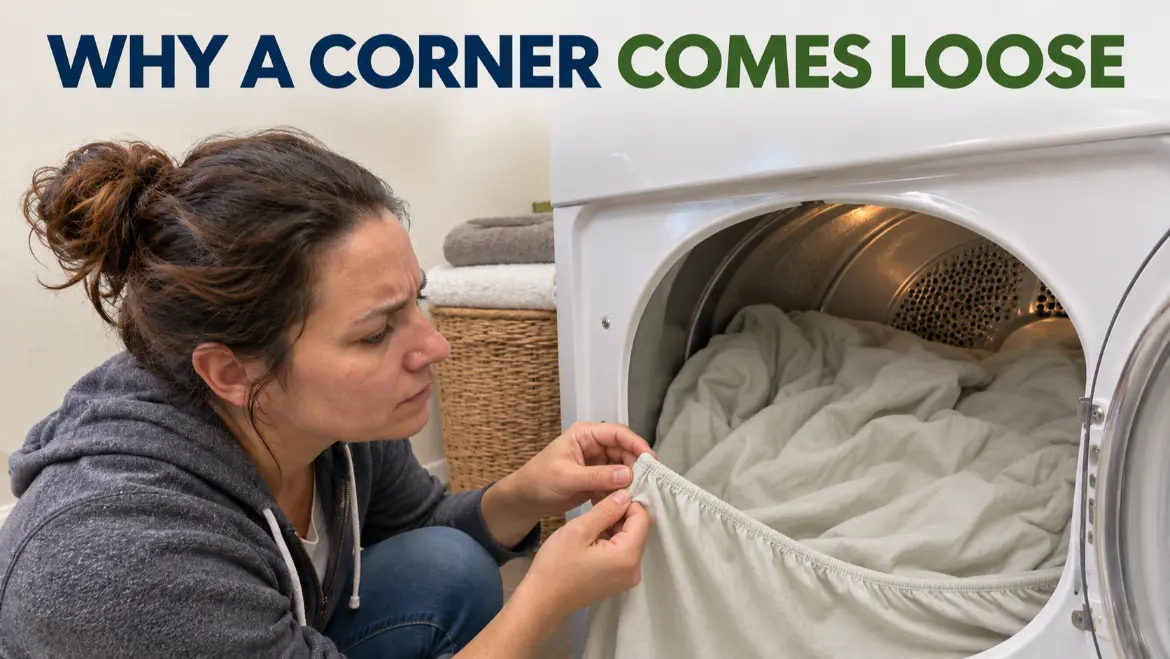
Check these points before deciding that the product does not work:
- The clear tab should be completely covered with fabric.
- The fabric-covered tab must be pushed through the opening and slid fully into the channel.
- Leave enough slack so the sheet is not pulling against the tab throughout the cycle.
- Gently tug each corner before loading.
- Try the alternate corner-pocket seam location for thick elastic.
- Use one device per sheet.
- Do not crowd the drum with more bedding than it can tumble freely.
- Avoid high spin speed.
- Re-fluff each sheet before moving it from washer to dryer.
The official Wad-Free troubleshooting guide focuses heavily on attachment technique. That reinforces a central finding of this Wad-Free review: the device is simple, but results are not completely plug-and-play.
Fabric Compatibility and Cycle Limits
Wad-Free is not suitable for every sheet material. The manufacturer specifically excludes silk and rayon. That exclusion also covers fabrics marketed under names such as bamboo, eucalyptus, beechwood, viscose, modal, lyocell, acetate and Tencel.
Fabric exclusions are a decisive part of this Wad-Free review, not a minor warning to bury near the end.
Do not rely on the marketing name printed on the front of a bedding package. Read the sewn-in fiber-content label before attaching the device.
The manufacturer also advises against use on weakened, thinned or damaged bedding. Concentrating force near four attachment points could be a concern for fragile fabric. If a sheet already has worn elastic, small tears or weak seams, washing it without the accessory or replacing it may be safer.
Cycle compatibility matters as well. The device is designed to be used with the fabric-care instructions, and high spin speed should be avoided. If your routine depends on sanitizing bedding with settings outside the product and fabric guidance, skip the accessory rather than improvising.
Wad-Free Pros and Cons
The following Wad-Free review summary separates practical advantages from the conditions that may make the extra setup undesirable.
Pros
- Addresses the specific problem of sheets twisting into a dense wad.
- Can reduce towels or pillowcases becoming trapped inside a fitted sheet.
- Reusable rather than disposable.
- One package covers a standard flat-and-fitted-sheet load.
- Smooth construction without sharp metal clips.
- Can remain attached through both washer and dryer.
- May reduce drying time when tangled sheets are already causing major delays.
- Made in the USA according to the manufacturer.
- Replacement tabs are available separately.
Cons
- Adds an attachment and removal step to every bedding load.
- Has a learning curve, particularly with fitted-sheet elastic.
- A corner may release if insufficient fabric is secured.
- The largest drying-time claim should not be treated as a typical result.
- Not compatible with silk or rayon-based bedding.
- High-spin routines are unsuitable.
- Two devices handle only two sheets, so extra sheets require additional units.
- It cannot solve overloading or an undersized dryer drum.
- Return shipping for official-site US returns is generally paid by the customer.
Wad-Free vs Dryer Balls and Manual Untangling
Wad-Free and dryer balls solve different problems. Dryer balls move through the load and may help separate fabric while reducing static or softening items, depending on their material and the load. They do not physically control the four corners of a sheet.
This Wad-Free review therefore does not present dryer balls as an identical substitute, even though both accessories aim to improve laundry movement.
| Option | Best use | Main advantage | Main limitation |
|---|---|---|---|
| Wad-Free | Sheets repeatedly forming wads or trapping other laundry | Directly controls sheet corners | Requires setup and compatible fabric |
| Dryer balls | General load separation and reduced reliance on dryer sheets | Drop-in convenience | May not stop a fitted sheet from swallowing smaller items |
| Mid-cycle untangling | Occasional sheet bundles | No accessory purchase | Requires monitoring and opening the dryer |
| Dry sheets separately | Small households with available time | Reduces trapped mixed items | Uses separate cycles and may be inefficient |
| Air drying | Suitable climate and adequate space | Avoids tumble-dryer energy use | Requires time, hanging space and appropriate conditions |
For shoppers comparing small household improvements, the RYSE SmartShade comparison demonstrates the same broader decision rule: convenience products are worthwhile only when they solve a problem you experience regularly. A gadget that saves one household repeated frustration may add unnecessary steps for another.
That problem-first approach guides the final recommendation in this Wad-Free review.
Price, Shipping and Return Policy
The official price was $19.99 for two Wad-Free for Bed Sheets devices when checked on November 27, 2026. The product page advertised free US economy shipping, while expedited options may cost extra. Prices and offers can change, so verify the checkout total before purchasing.
Price matters in this Wad-Free review because the benefit is convenience rather than a necessary washing function.
According to the official refund policy, eligible US purchases from Wadfree.com can be returned within 30 days of receipt. The customer is generally responsible for return shipping, and proof of purchase is required. Products bought from another marketplace must be returned under that seller’s policy.
The manufacturer also warns about counterfeit marketplace listings. If purchasing from Amazon or Walmart, confirm the seller identity rather than assuming every listing uses authorized inventory.
Seller verification belongs in this Wad-Free review because a counterfeit product may not match the materials, construction or support described by the manufacturer.
This Wad-Free review considers $19.99 reasonable only if sheet tangling is a repeated problem. If the device prevents even a few frustrating dryer restarts, the convenience may justify the cost. If your current loads already dry evenly, the value proposition weakens quickly.
Who Should Buy Wad-Free?
Wad-Free is most likely to be useful if:
This Wad-Free review gives the strongest recommendation to households that recognize several of the following situations.
- Your fitted sheet regularly swallows pillowcases, towels or the flat sheet.
- You frequently find a damp center inside an otherwise dry bedding load.
- You stop the dryer to untangle sheets.
- Your washer becomes unbalanced when sheets twist together.
- You use compatible cotton, linen or cotton-blend sheets.
- Your washer and dryer have enough capacity for the bedding to tumble.
- You are willing to learn the correct attachment method.
The Wad-Free review verdict becomes more favorable when several of those points apply at once.
For a household that regularly restarts bedding loads, this Wad-Free review finds the small preparation step easier to justify.
Who Should Skip It?
Consider skipping Wad-Free if:
The negative recommendation in this Wad-Free review is equally important because excluded fabrics and unsuitable cycles can make the product a poor fit.
- Your sheets rarely tangle.
- Your dryer is too small for the bedding load.
- You use bamboo, eucalyptus, Tencel, viscose, modal, silk or another excluded fabric.
- Your sheets are worn, thinning or damaged.
- You routinely use high spin or care settings outside the instructions.
- You want a completely effortless accessory with no preparation.
- Saving one to six minutes would not change your laundry routine.
If your main goal is improving sleep rather than simplifying sheet care, a product such as the one discussed in StoreZiller’s Derila Ergo Pillow review addresses a different bedroom need. Keeping internal recommendations separated by purpose helps readers avoid buying an unrelated product for the wrong problem.
Is Wad-Free Worth It
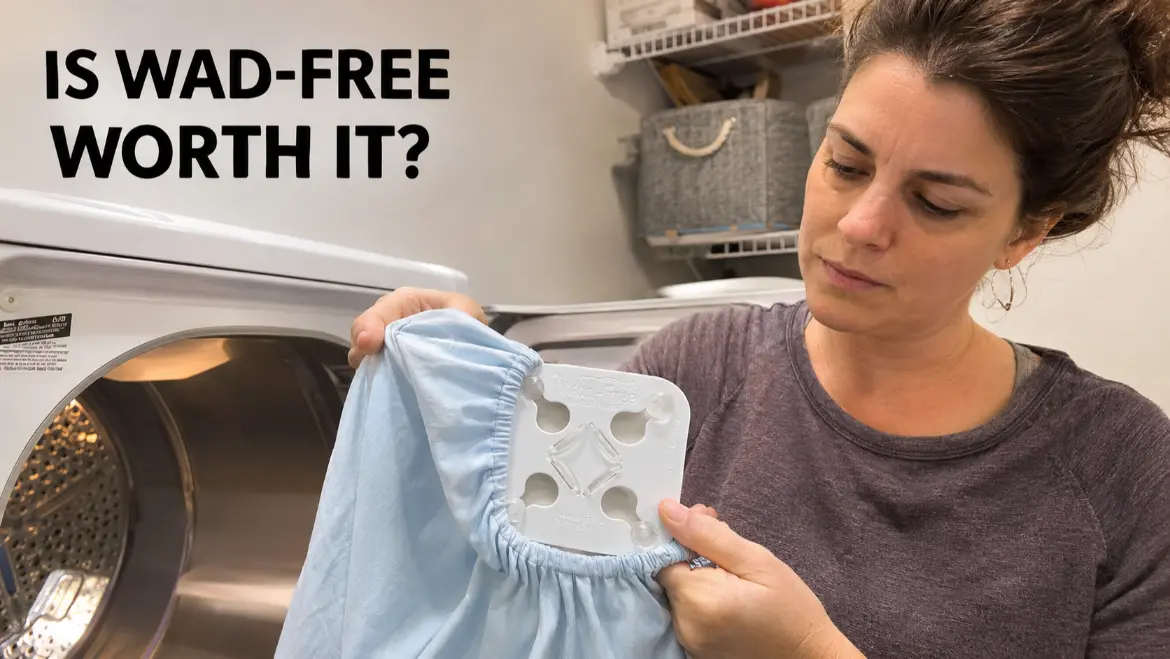
Our final Wad-Free review verdict is cautiously positive for a specific user, not universally enthusiastic. The product’s mechanical idea is reasonable, and both positive long-term use and controlled testing suggest that it can reduce laundry becoming trapped inside sheets. That is a real benefit for households battling the same dryer bundle every week.
The drying-time promise deserves restraint. Independent lab results were much smaller than the manufacturer’s best-case claim, and the device adds setup time. Its value therefore depends less on a dramatic percentage and more on whether it prevents your normal worst-case load.
For compatible cotton sheets in a properly sized machine, $19.99 is a defensible experiment, especially with the official 30-day return window. Read the fiber label, follow the instructions, secure enough fabric and judge the product across several loads rather than one attempt.
If your sheets already tumble freely or you use an excluded fabric, save the money. Wad-Free solves a narrow problem, and it is most worthwhile when that narrow problem happens often.
That conditional conclusion is the core of this Wad-Free review: useful for repeated tangling, unnecessary for trouble-free loads.
Frequently Asked Questions
These Wad-Free review questions cover the purchase, compatibility and setup details readers are most likely to need before ordering.
Does Wad-Free Really Work?
It can reduce sheets balling up and smaller laundry becoming trapped, but results vary. Correct attachment, sheet fabric, sheet size, appliance capacity and load composition all affect performance.
Does Wad-Free Make Sheets Dry 75 Percent Faster?
The manufacturer says “up to” 75 percent faster, which represents a possible maximum rather than a typical guarantee. Reviewed’s controlled tests found much smaller reductions. Expect the greatest potential benefit when severe tangling is already delaying your loads.
Can Wad-Free Be Used on King Sheets?
The manufacturer says it works with any flat or fitted sheet size as long as the appliance adequately fits the bedding. A king set may need more drum space than a queen set.
Do I Need One or Two Wad-Free Devices?
Use one device per sheet. A typical flat-and-fitted set needs two devices, which is the quantity included in one package.
Can Wad-Free Go in Both the Washer and Dryer?
Yes, it is designed to remain attached through washing and drying when the sheet-care and product instructions are followed.
Why Does My Wad-Free Keep Coming Loose?
Common causes include covering the tab with too little fabric, failing to slide it fully into the channel, attaching at unsuitable thick elastic, pulling the fabric too tightly, overloading the appliance or using an inappropriate cycle.
Can I Use Wad-Free on Bamboo or Tencel Sheets?
No. The manufacturer excludes rayon-based fabrics, including materials marketed as bamboo, eucalyptus, beechwood, viscose, modal, lyocell and Tencel.
Is Wad-Free Loud in the Dryer?
The official FAQ says users may hear an occasional tap, but the device is intended to be quieter than hard dryer balls or tennis balls.
How Long Does Wad-Free Last?
It is reusable, but lifespan varies with usage and care. The manufacturer says it can last a year or more depending on use and sells replacement tabs separately.
Was Wad-Free on Shark Tank?
Yes. The product appeared on Shark Tank Season 13, Episode 5, originally aired in November 2021.
This article contains affiliate links. If you purchase through our links, we may earn a commission at no extra cost to you. We only recommend products we genuinely believe in. Read our Affiliate Disclaimer for full details.