
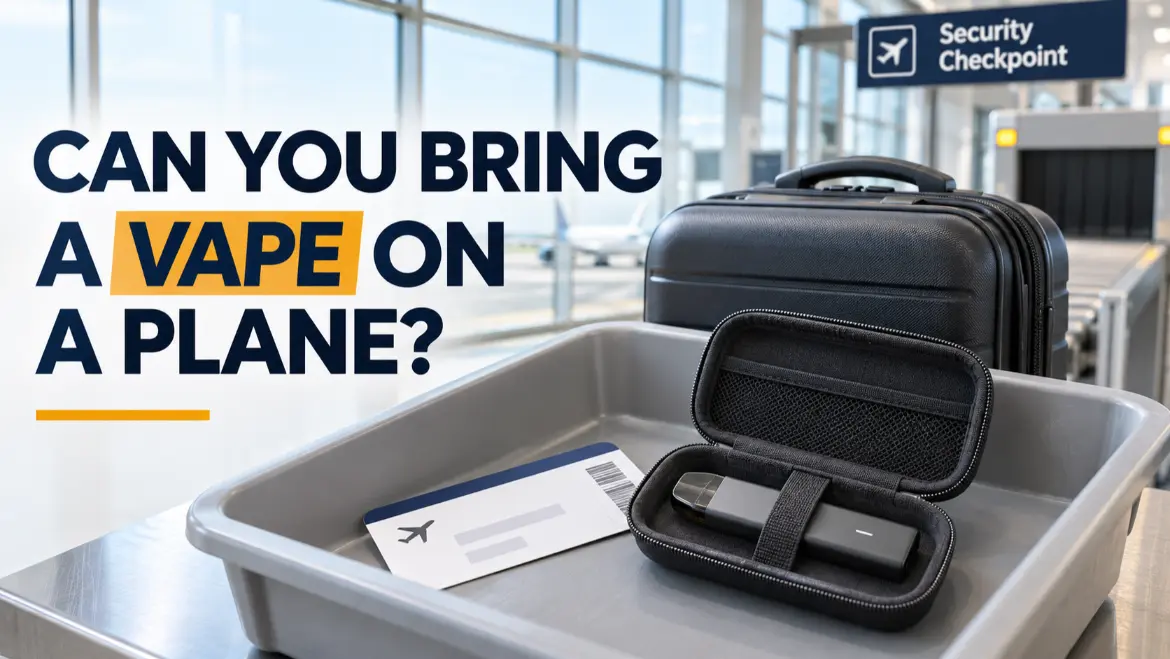
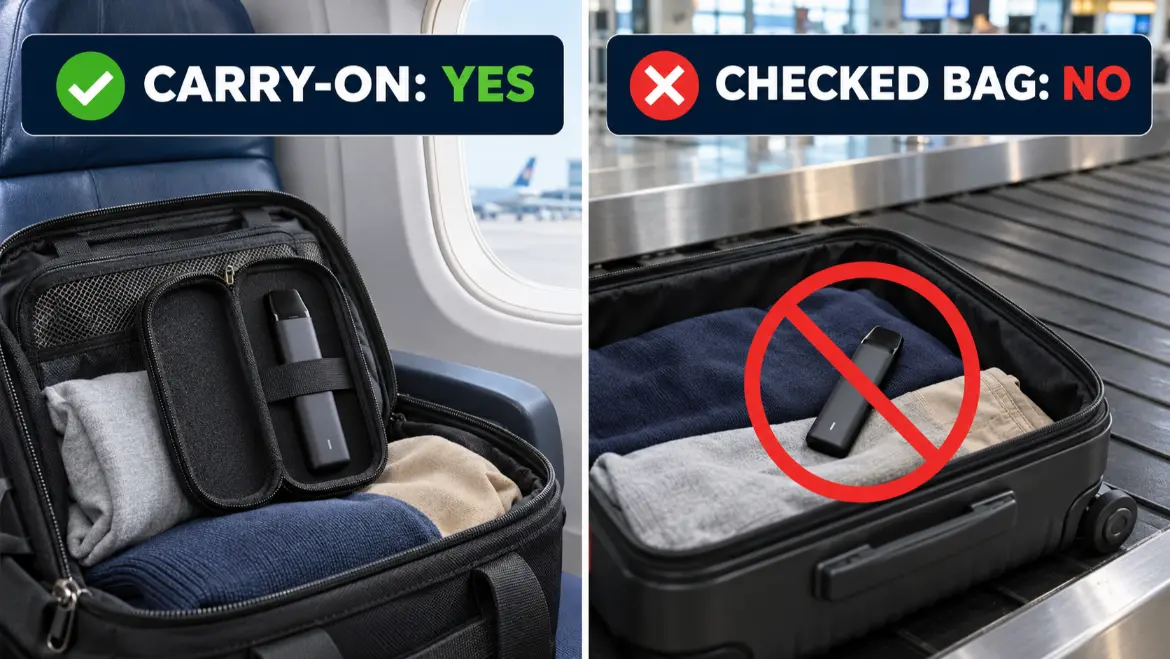
can you bring a vape on a plane? Yes, you can generally bring a vape on a plane, but the device must remain in your carry-on baggage or on your person. It cannot be packed in checked luggage. You must prevent accidental activation, protect spare batteries from short circuits, and follow the TSA liquid limit for refill bottles.
Table of Contents
The legality of the substance inside a cartridge is separate from the battery-safety rules. A device that is permitted in the cabin does not make every cartridge or liquid legal. You must also check your airline’s restrictions and the laws at your departure point, connection airport, and destination.
Quick Answer: Where Can You Pack a Vape?
| Item | Carry-On Bag | Checked Bag | Important Rule |
|---|---|---|---|
| Vape pen or electronic cigarette | Yes | No | Power it off and prevent accidental activation |
| Disposable vape | Yes | No | Keep it protected inside the cabin |
| Spare lithium battery | Yes | No | Cover the terminals or use an individual battery case |
| Refill liquid | Yes | Sometimes | Carry-on containers must follow the 3-1-1 liquid rule |
| Empty cartridge | Generally yes | Check airline rules | Protect it from leaks and damage |
| Filled cartridge | Depends on contents | Depends on contents | Both liquid and substance laws apply |
| Damaged or recalled battery | No | No | Do not travel with a battery that could overheat |
The simplest rule to remember is that the device and all spare batteries must stay with you inside the aircraft cabin.
Why Can You Bring a Vape in Carry-On but Not Checked Luggage?
Vaping devices are normally powered by lithium batteries. A damaged battery, exposed terminal, or accidentally activated heating element can overheat and potentially start a fire.
A battery incident is easier for trained crew members to identify and handle when it happens inside the cabin. A device buried inside checked baggage is much harder to access during a flight.
This is why electronic smoking devices are prohibited from checked luggage.
The FAA’s electronic cigarette and vaping-device guidance states that these devices must be carried on the passenger or placed in carry-on baggage. Travelers must also take effective measures to prevent the heating element from being activated accidentally.
This requirement applies to many common products, including:
- Disposable vapes
- Rechargeable vape pens
- Pod systems
- Personal vaporizers
- Electronic cigarettes
- Mods and atomizers
- Devices with removable lithium batteries
The rule is based on the battery and heating element, not simply the size or style of the device.
If you are still comparing personal-use devices, StoreZiller’s overview of popular vape brands provides a broader look at commonly available device categories. Always confirm that the exact model and battery meet current airline requirements before traveling.
Can You Take a Vape on a Plane in Your Pocket?
Federal air-safety rules allow an electronic smoking device to be carried on your person or inside your carry-on baggage. However, placing a loose device directly in your pocket is not always the safest option.
The activation button could be pressed accidentally when you sit down, move luggage, or place another object in the same pocket. Coins, keys, and other metal accessories can also create a problem around exposed battery terminals.
A safer approach is to:
- Turn the device completely off.
- Lock the firing button if the device has a locking function.
- Remove the battery when the design allows it.
- Keep the device inside a protective case.
- Separate it from keys, coins, and other metal items.
Do not rely only on sleep mode. The device should be secured so that the heating element cannot switch on inside your pocket or bag.
How to Pack a Vape for a Flight
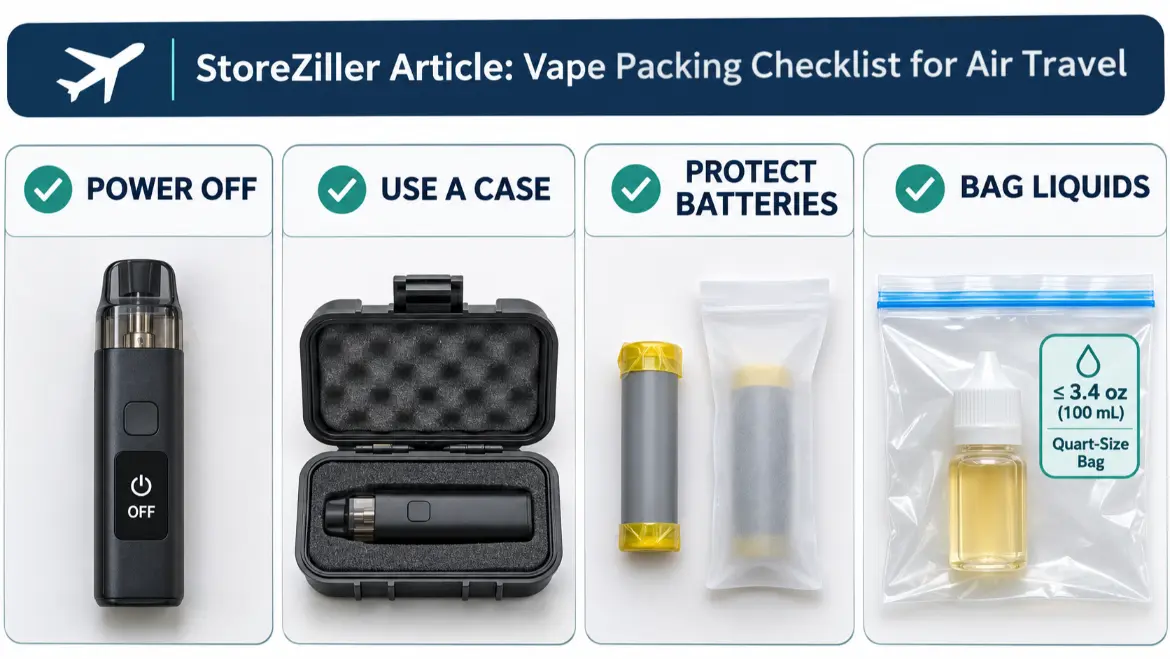
Proper packing does not require complicated equipment, but it requires more care than simply dropping the device into your suitcase.
1. Power Off the Device
Turn the device off using the manufacturer’s normal shutdown method. If it has a physical safety lock, activate it.
For devices without an off switch, use a rigid protective case that prevents pressure from reaching the activation area.
2. Prevent Accidental Activation
The FAA lists several ways to prevent accidental activation. These include removing the battery, separating the battery from the heating coil, placing the device in a protective case, using a safety latch, or activating the device’s built-in locking system.
The goal is to make it physically difficult for the heating element to turn on.
3. Protect Spare Batteries
Spare lithium batteries must remain in carry-on baggage. Never place an uncovered battery loose inside a backpack, purse, suitcase, or pocket.
Protect every spare battery individually by:
- Leaving it in the original retail packaging
- Covering exposed terminals with nonconductive tape
- Using an individual battery sleeve
- Placing it inside a dedicated plastic battery case
- Keeping it away from coins, keys, cables, and metal tools
According to the FAA passenger battery guidance, lithium-ion batteries rated at up to 100 watt-hours are generally permitted for personal use in carry-on baggage.
Airlines may still impose their own quantity restrictions, so check your carrier before packing several devices or batteries.
4. Use a Leak-Resistant Container
Changes in cabin pressure can cause a partly filled tank or cartridge to leak. Keep the device upright when possible, close all openings securely, and consider placing the tank or cartridge inside a small sealed plastic bag.
Do not overfill a refillable tank immediately before departure.
5. Keep the Device Accessible
Pack the device somewhere you can reach without emptying your entire bag. This becomes especially important if the airline unexpectedly asks you to check your carry-on at the gate.
If airline staff gate-check your bag, remove the device and all spare lithium batteries before handing over the bag. Keep them with you inside the cabin.
Do Vape Liquids Follow the TSA 3-1-1 Rule?
Yes. Liquids carried through a United States airport security checkpoint generally follow the TSA 3-1-1 rule.
Each liquid container in your carry-on must be:
- 3.4 fluid ounces or 100 milliliters or smaller
- Placed inside a single quart-size clear resealable bag
- Limited to one liquids bag per passenger
A half-full 4-ounce bottle can still be rejected because airport security considers the maximum capacity of the container, not just the amount of liquid remaining inside it.
The official TSA travel checklist confirms that liquids, gels, and aerosols must meet the 3.4-ounce container limit and fit inside one quart-size clear bag.
Larger refill bottles may sometimes be placed in checked luggage, subject to airline policies and destination laws. However, the battery-powered device itself must remain in the aircraft cabin.
To reduce the risk of leaks:
- Tighten bottle caps carefully
- Place each bottle inside a small sealed bag
- Leave a little empty space in refillable containers
- Keep bottles upright when possible
- Avoid placing liquid beside clothing or electronics without secondary protection
Can You Bring a Cart Through TSA?
A cartridge is not evaluated only as a device accessory. Airport officers may consider the cartridge’s contents, whether it contains liquid, its connection to a battery-powered device, and whether the substance is legally permitted.
An empty cartridge or a cartridge containing a legally permitted nicotine liquid may generally be packed in carry-on baggage, provided it complies with the liquid limit and airline rules.
Keep the cartridge sealed to prevent leaking. Placing it inside a small clear plastic bag can provide extra protection if pressure changes cause liquid to escape.
However, a cartridge containing an illegal or restricted substance creates a separate legal issue. The fact that a cartridge fits into an otherwise permitted vape pen does not make its contents acceptable.
Do not use unmarked or misleading packaging. Do not attempt to hide a cartridge or provide inaccurate information about its contents.
Airport screening can include additional inspection, and suspected illegal items may be referred to airport law enforcement.
If you cannot verify that a cartridge and its contents are legal at every point of your journey, the safest choice is to leave it at home.
Can You Bring a Weed Vape Through TSA?
Do not bring a weed vape through TSA when its contents are prohibited under applicable federal, state, airport, or destination laws.
TSA screening is primarily designed to identify threats to transportation security. However, that does not mean officers ignore suspected illegal substances discovered during screening.
If a security officer encounters a suspected prohibited substance, the item and passenger may be referred to local law enforcement.
State-level permission does not automatically settle the issue at an airport, during a connecting flight, on federal property, or when crossing an international border.
The laws may be different at:
- Your home location
- The state where the departure airport is located
- A connecting airport
- Your final destination
- A foreign country’s customs checkpoint
International travel creates an especially serious risk because another country may prohibit the device, the cartridge, or both. Some destinations impose strict penalties even when the traveler legally purchased the product at home.
Never assume that a product is permitted at your destination simply because it was purchased legally in your home state.
Can You Take Electronic Cigarettes on a Plane?
Electronic cigarettes are generally permitted inside the aircraft cabin when safely packed. They are not permitted in checked baggage.
The same central precautions apply:
- Keep the device in carry-on baggage or on your person
- Power it off completely
- Prevent accidental activation
- Protect exposed battery terminals
- Keep spare batteries in the cabin
- Follow carry-on liquid restrictions
- Do not use or charge the device onboard
The United States Department of Transportation electronic cigarette rule explicitly prohibits the use of electronic cigarettes on commercial flights where smoking is banned.
This means that permission to carry the device does not include permission to use it.
Can You Use or Charge a Vape on the Plane?
No. You cannot use or recharge a vape during the flight.
This restriction applies even if the airline seat includes a USB port or electrical outlet. Connecting the device to the aircraft’s power supply is not permitted.
Do not:
- Vape in your seat
- Use the device inside an aircraft restroom
- Charge it with a seat outlet
- Connect it to a power bank
- Test the heating element
- Activate it to confirm that it still works
The Department of Transportation’s checked-baggage and onboard charging rule prohibits passengers from carrying electronic smoking devices in checked baggage and from charging the devices or batteries aboard an aircraft.
Follow all cabin-crew instructions. Violating these restrictions may result in removal from a flight, airline penalties, or enforcement action.
What Happens at the TSA Checkpoint?
A vape pen may remain inside your carry-on while your bag passes through X-ray screening unless an officer instructs you to remove it.
Screening procedures can vary depending on the airport, screening equipment, bag contents, and instructions from the security officer.
An officer may:
- Ask you to remove the device from your bag
- Inspect the device or cartridge
- Request additional screening
- Ask what an item is
- Refer a suspected prohibited item to law enforcement
Pack the device so that it is easy to identify and remove. A clean protective case is better than hiding it underneath clothing or placing it among tangled cables and loose batteries.
The final decision about whether an item can pass through the security checkpoint rests with the screening officer.
Airline acceptance, destination restrictions, and possession laws remain separate considerations.
Do Domestic and International Flights Have Different Rules?
The FAA battery requirements provide a useful baseline for flights departing from the United States, but international travel can involve additional restrictions.
Before taking a device on an international flight, check:
- Your departure country’s rules
- Every connecting country’s transit restrictions
- Your destination country’s import and possession laws
- The airline’s dangerous-goods policy
- Airport-specific restrictions
- Rules covering the substance inside the cartridge
Some airlines limit the number of electronic smoking devices or spare batteries a passenger may carry. Certain countries prohibit the importation, possession, or use of vaping devices entirely.
Do not rely only on an old travel forum, social-media comment, or another passenger’s experience. Regulations can change, and the traveler’s route or product may have been different from yours.
Use the airline’s official baggage page and the destination government’s current customs information.
What If Your Carry-On Is Gate-Checked?
A bag originally intended for the cabin may be moved into the cargo hold because the overhead compartments are full or the aircraft is too small for standard carry-on luggage.
Before handing over the bag, remove:
- The vape device
- Disposable electronic cigarettes
- Spare lithium batteries
- Battery charging cases
- Power banks
- Other loose lithium batteries
The FAA lithium-battery baggage guidance states that electronic cigarettes, vaping devices, power banks, and spare lithium batteries must be removed when a carry-on bag is checked at the gate or planeside.
Keep a small protective pouch near the top of your carry-on. This allows you to remove restricted battery-powered items quickly without opening and reorganizing your entire suitcase at the gate.
Common Mistakes Travelers Should Avoid
Packing the Device in Checked Luggage
This is the most important packing mistake to avoid. Electronic smoking devices cannot travel in checked baggage, even when they are fully powered off.
Leaving the Device Unlocked
A device can activate when it is pressed against another item. Use its locking function and place it in a protective case.
Carrying Loose Batteries
Exposed battery terminals can come into contact with metal and cause a short circuit. Store each spare battery separately.
Packing an Oversized Liquid Bottle
A liquid container larger than 3.4 ounces may be rejected at the security checkpoint even when it is nearly empty.
Forgetting About Gate Checking
Remove the device, power bank, and spare batteries before a cabin bag is placed in the aircraft’s cargo hold.
Charging During the Flight
Onboard charging is prohibited. Charge the battery before arriving at the airport and leave it disconnected throughout the flight.
Ignoring Destination Laws
TSA screening requirements do not override airline policies, local possession laws, customs regulations, or foreign-country restrictions.
Traveling With a Damaged Battery
Do not fly with a battery that is swollen, leaking, unusually hot, punctured, recalled, or physically damaged.
Damaged batteries can overheat or create sparks. If you are uncertain about the condition of a battery, replace it before traveling.
A Practical Pre-Flight Checklist
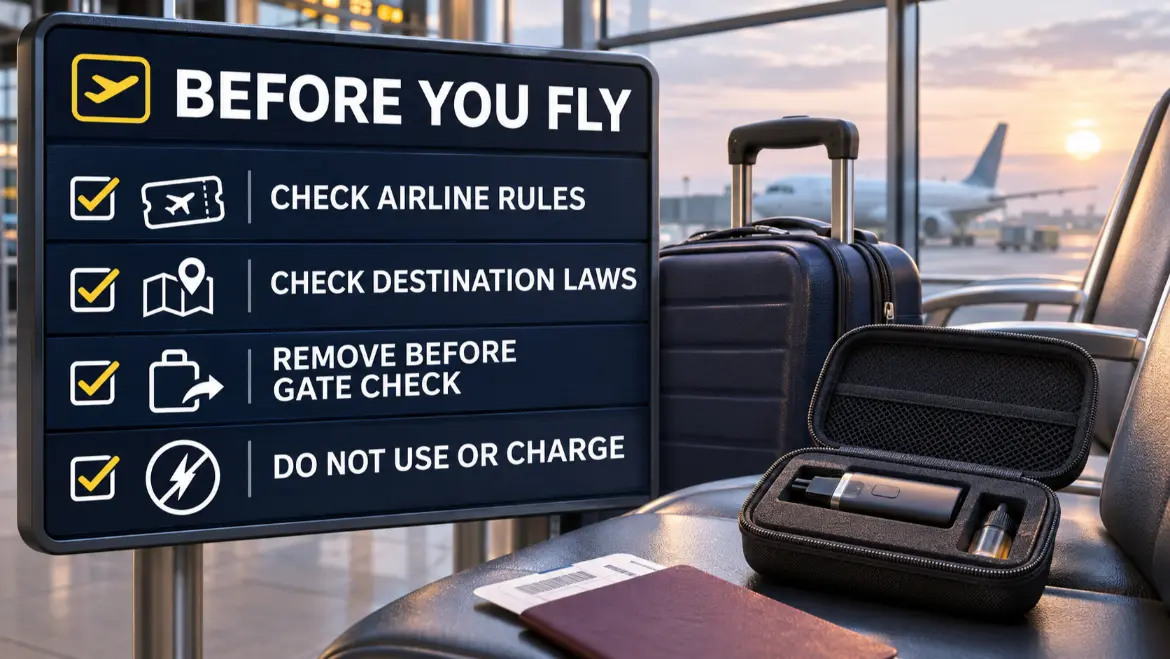
Use this checklist before leaving for the airport:
- Confirm that the device and cartridge are legal throughout the itinerary
- Read the airline’s current baggage policy
- Turn the device completely off
- Lock the activation button
- Place the device inside a protective case
- Protect each spare battery individually
- Keep the device and batteries in carry-on baggage
- Place refill liquids in the quart-size liquids bag
- Check that every liquid container is no larger than 3.4 ounces
- Inspect the battery for damage, swelling, leaks, or recalls
- Prepare to remove the device if your bag is gate-checked
- Do not use or charge the device onboard
Travel also creates risks for other valuables. Keeping payment cards and identification organized can make airport security and crowded terminals easier to manage. StoreZiller’s Wallet Defender review examines one type of compact card-storage accessory intended for everyday and travel environments.
Before a major trip, it is also sensible to make a second copy of important phone photos and documents. StoreZiller’s guide to creating a physical phone backup explains one approach for storing compatible files outside your phone.
Frequently Asked Questions
Can you bring a disposable vape on a plane?
Yes. A disposable vape is generally permitted in carry-on baggage or on your person. It cannot be placed in checked baggage. Keep it protected from damage and accidental activation. If your carry-on is checked at the gate, remove the disposable device before handing over the bag.
Will TSA take my vape out of my bag?
A security officer may inspect any item that requires additional screening. Pack your device somewhere accessible and follow all instructions given at the checkpoint.
Can you put vape liquid in checked luggage?
A larger refill bottle may sometimes travel in checked luggage, subject to airline rules and destination laws. Protect it carefully against leaks. The battery-powered device itself cannot be placed in checked baggage.
Can you put a vape in your personal item?
Yes. A personal item that remains with you inside the cabin is generally treated as carry-on baggage. Secure the device inside a protective case and ensure that it cannot activate accidentally.
Can you bring more than one vape on a plane?
Devices intended for personal use may generally be permitted, but airlines can impose quantity restrictions. A large number of devices or batteries may raise questions about whether the items are intended for personal use or commercial distribution. Confirm your airline’s policy before packing several devices.
Do you have to remove a vape at airport security?
Not necessarily. It may remain inside your carry-on unless a security officer instructs you to remove it. Screening procedures can vary between airports.
Can you charge a vape with a power bank during the flight?
No. Do not recharge the device or its battery onboard, including through a power bank, USB port, or aircraft electrical outlet.
Can you take a vape on a plane without a cartridge?
Yes. The same battery-safety restrictions still apply to an empty device. Keep it powered off, protect it from accidental activation, and pack it in your carry-on baggage.
What should you do if the device becomes hot?
Notify a crew member immediately if a device or battery becomes unusually hot, begins expanding, produces an unusual smell, smokes, or shows another sign of failure. Do not hide it inside a bag or attempt to handle a failing battery without guidance from trained crew members.
Final Answer
You can bring a vape on a plane when it is legally possessed, safely packed, and kept inside the aircraft cabin. Never place the device or spare lithium batteries in checked baggage.
Power the device off, prevent accidental activation, protect all spare battery terminals, and place carry-on liquids inside the required clear liquids bag.
If your carry-on is checked at the gate, remove the device, spare batteries, and power banks before handing over the bag.
Remember that permission to carry the hardware does not automatically make every cartridge or liquid legal. Check your airline’s policy and the laws at every point of your journey before traveling.